
What is Shell Mold Casting
Shell mold casting (also referred to as shell‑mould casting or pre‑coated sand casting) is an expendable‑mold foundry process. It utilizes fine silica sand coated and bonded with thermosetting phenolic resin to create thin‑walled, rigid shell‑shaped casting molds. Positioned between conventional green‑sand casting and investment casting, this technology is widely adopted for medium‑to‑high‑volume metal components that demand tight dimensional tolerances and smooth as‑cast surfaces. It is applicable to grey cast iron, ductile iron, carbon steel, alloy steel, as well as non‑ferrous alloys including aluminum and brass. Baoding Guokun is a well‑established casting manufacturer based in China. Shell‑mold casting is one of our primary production processes, with which we produce custom shell‑mold cast iron parts. Adopting pre‑coated sand shell‑mold casting technology, we are capable of manufacturing high‑accuracy grey cast iron and ductile iron castings with tight tolerances and superior as‑cast surface quality. Our shell‑mold cast iron components are widely applied in pumps, valves, motor frames, flanges, gearbox, reducer, mining, agriculture, compresor and general machinery assemblies. We provide full‑service OEM customization strictly according to customer drawings, 3D files or physical samples. Both medium‑volume and high‑volume production orders are acceptable. Strict in‑house quality control including material chemical composition testing, dimensional inspection and visual checking is implemented for every batch before shipment.
Core Production Steps of Shell Mold Casting
Step 1: Metal pattern preparation
Produce split‑type metal pattern (cope half & drag half) from cast iron or steel. Aluminum pattern is optional for low‑batch orders. Apply release agent (calcium stearate) on pattern surface, heat the pattern to 220‑340℃ for subsequent sand adhesion.
Step 2: Dump box sand coating & partial curing
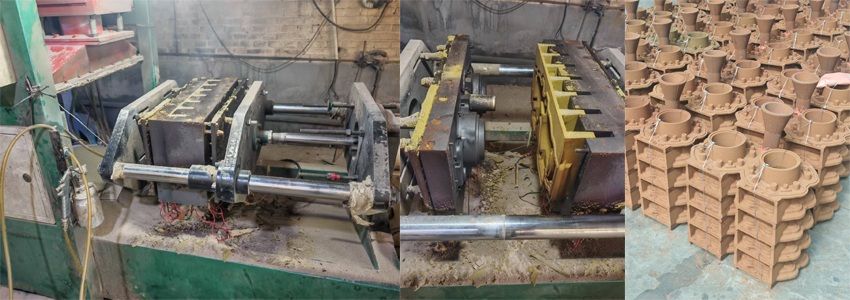
Clamp heated pattern onto dump box filled with pre‑coated resin sand. Invert the dump box, free‑flowing resin‑coated sand covers the hot pattern surface. The phenolic resin melts and sticks silica sand grains together, forming a semi‑cured shell layer with controlled thickness 5‑12 mm.
Step 3: Complete oven curing
Transfer pattern with semi‑finished shell into curing oven at 290‑370 °C for 30‑180 seconds. The resin is fully thermoset to gain high tensile strength, forming hard, dimension‑stable shell mold halves.
Step 4: Shell ejection & core insertion
Eject cured shell cope and drag from metal pattern via ejection pins. Insert pre‑made shell cores or hot‑box sand cores if internal cavities, holes or hollow structures are required for castings.
Step 5: Shell mold assembly & backing filling
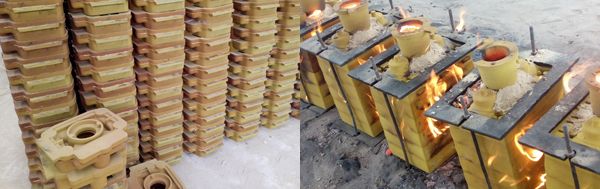
Bond two shell halves with phenolic adhesive and lock by mechanical clamps to eliminate parting‑line flash. Place assembled shell mold inside steel pouring flask, fill surrounding gap with steel shot or coarse sand as backing support, preventing thin shell cracking or shifting under molten‑metal metallostatic pressure during pouring.
Step 6: Pouring, cooling & shakeout
Pour molten metal through pre‑designed gating‑riser system into shell mold cavity. After full solidification and cooling, break the brittle shell mold. Shake out sand residue, remove gating and risers, then conduct shot blasting, grinding and non‑destructive inspection for finished shell‑mold castings.
Advantages of Shell Mold Casting
- Superior dimensional accuracy: Typical tolerance ISO CT7‑CT9, ±0.25~0.5 mm, far better than green sand casting; minimum draft angle down to 0.5°, reducing material waste.
- Excellent as‑cast surface finish: Ra 1.6‑6.3 μm, greatly reduces CNC machining allowance and downstream machining cost.
- Good mold permeability: Efficient gas venting during pouring, lower risk of porosity, pinholes and blowhole casting defects.
- Stable repeatability for mass production: Reusable metal patterns support automated shell‑making lines, high cycle efficiency for medium‑to‑high batch production from 1000 up to 100 000 pieces per order.
- Capable for thin‑wall intricate geometry: Successfully produce thin‑wall sections (cast iron ≥4 mm), fine features and complex outer contours compared to conventional sand casting.
- Broad alloy compatibility: Workable for grey iron, ductile iron, cast steel, stainless steel, aluminum alloy, bronze and brass components.
Disadvantages & Limitations of Shell Mold Casting
- Part size limitation: Mainly for small‑to‑medium‑size castings, general weight range 0.03 kg‑30 kg; not suitable for extra‑large heavy castings.
- Higher upfront tooling investment: Custom‑machined metal pattern, dump box, heating and curing equipment bring higher initial cost; not cost‑effective for very low‑volume trial orders or one‑off prototypes.
- Expensive raw material: Pre‑coated phenolic resin sand costs more than ordinary green sand; each shell mold is expendable and destroyed after single pouring cycle.
- Environmental concern: Phenolic resin releases small amount of volatile gas during heating and pouring, requiring factory exhaust treatment system.
Shell Mold Casting Pattern / Tooling Design Guidelines
- Pattern material selection: Cast iron / steel pattern for mass‑volume long‑run production; aluminum pattern for small‑batch jobs with lower thermal load. Pattern must resist repeated thermal cycling without deformation.
- Draft angle recommendation: External surface 0.5°‑1°, internal cored surface 1°‑3°, much smaller than green sand casting requirement. Deep‑recess features adopt larger draft angle to avoid shell tearing while ejection.
- Wall‑thickness rule: Minimum wall thickness: ductile/grey iron ≥4 mm, cast steel ≥5 mm, aluminum alloy ≥3 mm. Avoid abrupt thickness mutation; apply generous fillet radii at wall junctions to prevent shrinkage cavity and hot‑crack defects.
- Machining allowance: Normally 1.5‑3 mm for critical mating surfaces, less than traditional sand casting allowance.
- Parting‑line arrangement: Place parting line at non‑critical cosmetic surface to minimize flash generation; set ejection pins on non‑machining non‑appearance area to avoid surface marks on castings.
- Gating‑riser system design: Optimize sprue, ingate and riser layout for directional solidification; guarantee smooth metal filling, trap slag effectively and feed hot‑spot positions to reduce shrinkage defects. Vent slots shall be reserved for gas discharge from shell mold cavity.
Typical Industrial Applications for Shell Mold Casting
- Automotive industry: Engine accessories, transmission housing, bearing housing, valve body, connecting rod, brake system shell‑molded iron parts.
- Fluid handling equipment: Pump housing, pump cover, impeller, clean‑out cover, flange, hydraulic valve body for oil‑gas and water‑treatment systems (very common for our mechanical casting export business).
- General industrial machinery: Gear housing, machine‑tool base accessories, bushing, bracket, coupling parts made by shell mold casting.
- Electrical equipment: Motor frame, motor end cover, high‑voltage insulator flange, electrical cabinet cast iron components.
- Construction & agricultural machinery: Small structural brackets, joint components, hydraulic manifold bodies with medium‑high batch quantity
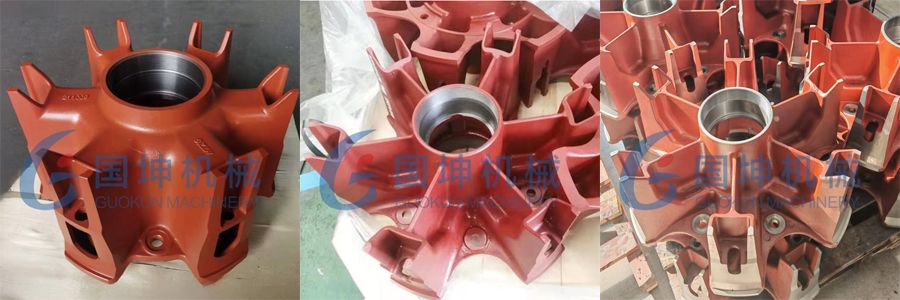
China sand casting ductile iron trailer wheel hub manufacturer
A High Quality China Foundry!
Guokun Casting, of Baoding Hebei is an ISO 9001-2008 registered iron and steel foundry & supplier of high quality carbon steel, cast iron and machined castings used in power, mining, railway, agricultural, tillage, truck, automobile, pump, valve, motor, pipe fittings and gear industry.
With a montly capacity of 100,000kgs and with more than 25 years of experience ensure the short delivery and the highest valued iron & steel casting parts.
Pump casting, Valve casting, agricultural casting, aircraft casting, railway casting, road casting, motor casting, mining casting, power generation investment casting, Medical casting, marine industry casting
Baoding Guokun Machinery Co., Ltd.
Baoding Guokun Export and Import Trading Co., Ltd
Office Add: 777# Chaoyang South Street, Baoding City, Hebei, 071000, China
Factory Address: Wangdu County, Baoding City, Hebei, 071000, China
Website: www.metalcastingfactory.com
Tel: 86-312-5951319 Fax: 86-312-5951296
Phone: 86-181 3278 9710 (WhatsApp & WeChat)
Email: gina@guokuncasting.com