
What is the difference between NEMA and IEC motor standards?
Baoding Guokun is the China professional casting foundry who mainly produce the standard and customized electric motor frame, motor housing, end shield and other motor castings in cast iron and aluminum alloy, for example, EN-GJL-200, EN-GJL:-250, EN-GJL-300, GG20, GG25, EN-GJS-500, etc. We have produced a lot of customized electric motor casting parts for IEC motor and NEMA motors.
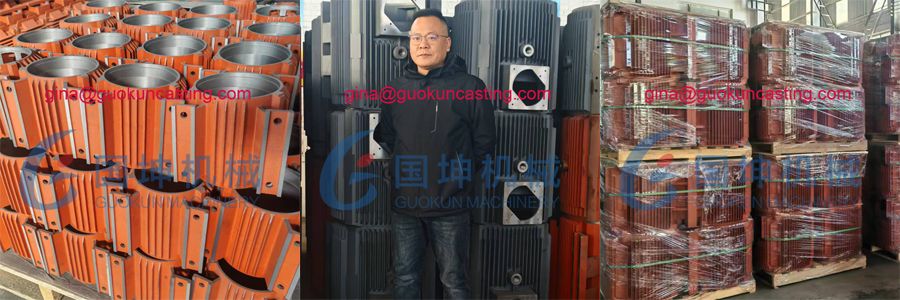
China cast iron motor casing factory
Today, we would like to introduce two dominant standards: IEC and NEMA. Motor standards provide the framework for consistency, safety, and performance across global manufacturing and industrial applications. These standards define specifications for design, construction, performance characteristics, and testing protocols.
IEC motor standards, primarily from the International Electrotechnical Commission (IEC), serves as the global standard adopted by most countries worldwide. IEC electric motors, focusing on compatibility, safety and performance, especially via IEC60034 series for efficiency (IE1, IE2, IE3, IE4), dimensions (frame size like IEC 160, 355M) and performance, ensuring international interchangeability for pumps, fans and conveyors.
NEMA (National Electrical Manufacturers Association) standards provide guidelines for electric motor specifications, primarily focusing on interchangeable physical dimensions (frame sizes), mounting, and performance classes (A, B, C, D) for North American applications, ensuring motors fit standard bases and have predictable starting/torque characteristics, though not defining exact power or shaft length.
|
IEC Motor Characteristics |
NEMA motor Characteristics |
| Metric Standards: Uses metric units (mm) for frame sizes, shaft height (H dimension), and mounting, ensuring global interchangeability. 160, 200, 355M, etc. | Imperial Standards: Uses imperial measurements with specific motor frame designations (143T, 184T, 213T, etc.) |
| Efficiency: Adheres to IE (International Efficiency) classes (IE1, IE2, IE3, IE4), with IE4 being the highest, focusing on energy savings. | Service Factor Advantage: NEMA motors typically include a service factor (commonly 1.15), allowing continuous operation at 15% above nameplate rating |
| Frame & Mounting: Defined by H-dimension (e.g., 132mm), offering flexible mounting (F1, F2) and standardized IP (Ingress Protection) & IC (Internal Cooling) codes. | Frame & mounting: Defined by the center of shaft height and denotes the dimensions or locations of the mounting holes in the base. |
| Design: Compact, lightweight, with high starting torque, low noise, and robust construction | Conservative Design: Built with higher safety margins and more robust construction
|
| Applications: Used globally in general machinery, pumps, fans, conveyors, and automation, especially for equipment originating from Europe. | Applications: They provide standardized, reliable power for general purpose, high-efficiency, or specialized high-torque needs across sectors like water treatment, HVAC, food processing, and mining |
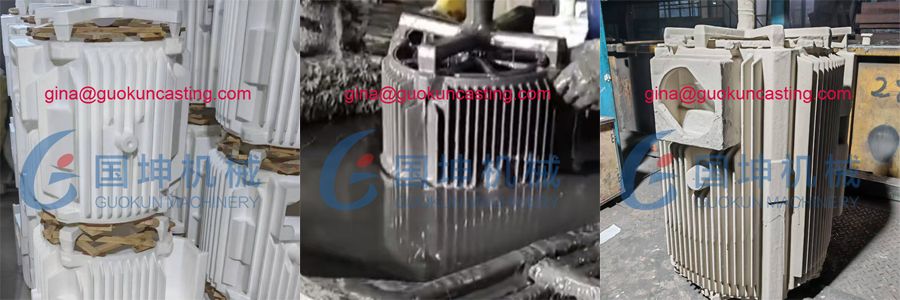
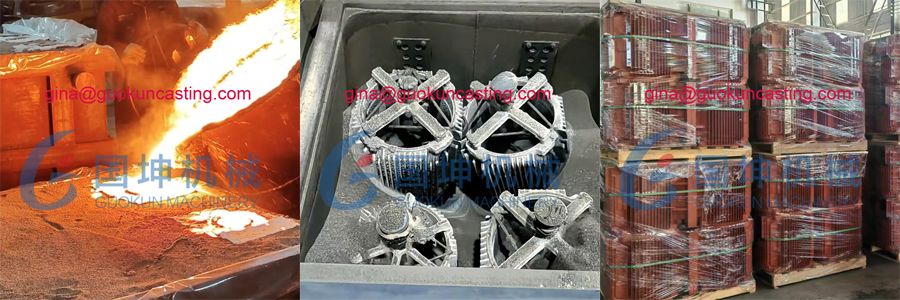
Baoding Guokun can use the lost foam casting process and sand casting process to produce the motor frame, motor housing and other motor castings.
What is lost foam casting process?
Lost-foam casting is a type of evaporative-pattern casting process that is similar to investment casting except foam is used for the pattern instead of wax. The lost foam casting techniques take advantage of the low boiling point of polymer foams to simplify the investment casting process by removing the need of melt the wax out of the mold. Compared with investment casting method and sand casting techniques, lost foam casting is one of the most cost-effective and environmentally friendly metal casting process for creating complex and intricate metal parts by using a foam pattern that evaporates when molten metal is poured into it:
| Lost foam casting process | |
| Create the foam pattern | Create the foam pattern: The pattern is made from pre-expanded polystyrene (EPS) that is heated in an aluminum die to expand and fuse the beads. The pattern can be carved, machined, or created using injection molding. |
| Coat the foam | A ceramic refractory coating is applied to the foam to protect it from the sand and create a barrier |
| Compact the sand | The foam pattern is placed in a flask and surrounded by unbonded sand, which is compacted using a vibration table. |
| Pour the metal | Pour the metal: Molten metal is poured into the flask, causing the foam to evaporate and leaving behind the metal |
| Remove the coating | Remove the coating: The refractory coating is removed to expose the metal part. |
| Surface treatment | Sandblasting and machine process. |
A High Quality China Metal Casting Foundry!
Guokun Casting, of Baoding Hebei is an ISO 9001-2008 registered iron and steel foundry & supplier of high quality carbon steel, cast iron and machined castings used in power, mining, railway, agricultural, tillage, truck, automobile, pump, valve, motor, pipe fittings and gear industry. we also can offer investment casting and sand casting process for your custom metal products.
With a monthly capacity of 10,000kgs and with more than 25 years of experience ensure the short delivery and the highest valued iron & steel casting parts.
Pump casting, Valve casting, agricultural casting, aircraft casting, railway casting, road casting, motor casting, mining casting, boiler casting, power generation investment casting, Medical casting, marine industry casting
Baoding Guokun Machinery Co., Ltd.
Baoding Guokun Export and Import Trading Co., Ltd
Office Add: 777# Chaoyang South Street, Baoding City, Hebei, 071000, China
Factory Address: Wangdu County, Baoding City, Hebei, 071000, China
Website: www.metalcastingfactory.com
Tel: 86-312-5951319 Fax: 86-312-5951296
Phone: 86-181 3278 9710 (WhatsApp & WeChat)
Email: gina@guokuncasting.com